Long Operating Hours
Advertising lightboxes usually cover concourses, platforms, corridors and other areas, with electricity costs accumulating over long operating periods.

Display-Based Lighting Energy-Saving Solution
Enable energy savings, remote management and sustained operating improvement for advertising lightboxes through intelligent dimming and a digital operations platform.
Metro advertising lightboxes are numerous, widely distributed and operate for long hours. Without unified digital energy management, energy use becomes hard to see, scheduling is delayed and savings are difficult to evaluate.

Advertising lightboxes usually cover concourses, platforms, corridors and other areas, with electricity costs accumulating over long operating periods.
Traditional lightboxes often run at fixed brightness and cannot automatically adjust by time period, passenger flow or ambient light.
Lightboxes are distributed across stations and areas, making manual inspection, switching and troubleshooting inefficient.
Without unified energy and operating data, it is difficult to quantify savings potential and operational improvement.
The lightbox itself is not the issue. The gap is digital energy management.
Build a closed loop for digital lightbox energy management with intelligent terminals, communications, a cloud platform and operations decision support.
Deploy dimming controllers, energy metering devices and status monitoring terminals to make each lightbox visible and controllable.
Use a stable communication network to upload device data and issue remote control commands.
Manage lightbox devices, operating data, energy data, alerts and energy-saving strategies in one platform.
Use operating data for energy-saving analysis, strategy optimization, benefit assessment and maintenance management.
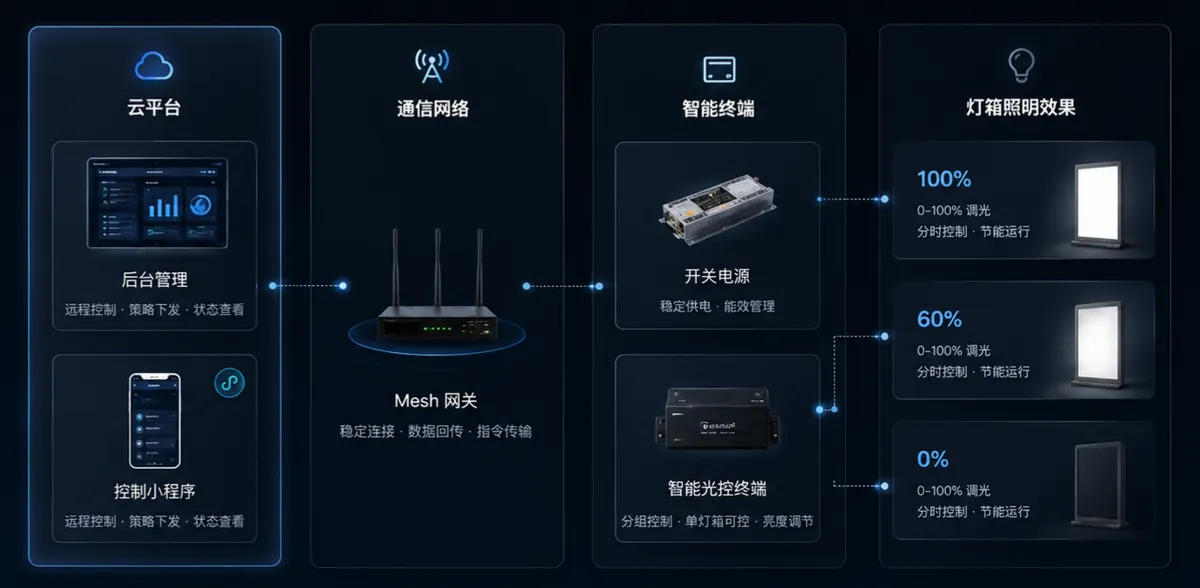
Use real-time data to drive brightness strategies, device control and maintenance response, forming a closed loop for lightbox energy management.
Adjust lightbox brightness by area, time period, traffic and ambient light to reduce unnecessary lighting energy use.
Collect lightbox energy consumption and operating status in real time to support savings calculation and operational assessment.
Support remote switching, brightness policy delivery, group control and status viewing to reduce on-site operating costs.
Issue timely alerts for device exceptions, abnormal energy use and offline status to improve maintenance response.
Use a standardized implementation approach to manage project schedule, installation quality and ongoing operating results.
Review lightbox quantity, installation locations, power conditions, current operating hours and management methods.
Estimate savings potential based on operating hours, lightbox power and management strategy.
Define dimming strategies, device configuration, platform functions and implementation plan.
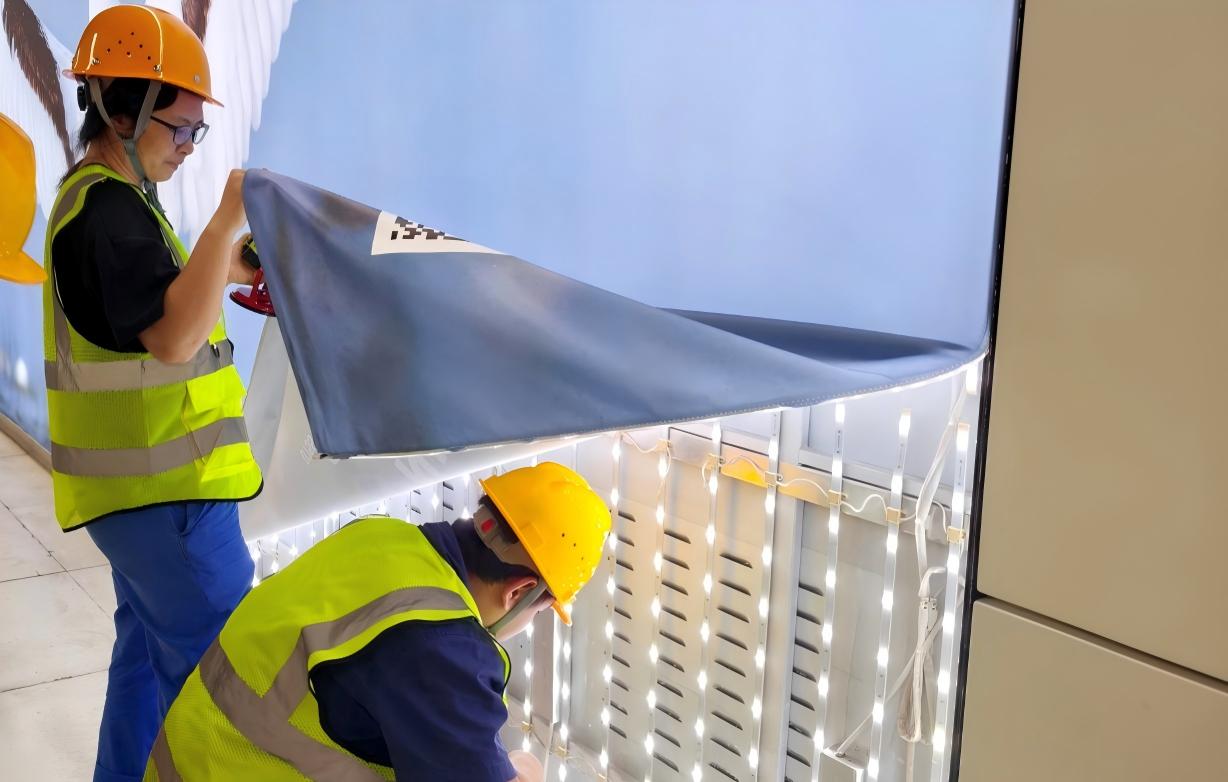
Complete device deployment, control integration, system commissioning and on-site acceptance.
Continuously track energy data, optimize control strategies and provide maintenance support.
Compare management efficiency and estimated energy-saving performance before and after renovation under consistent operating boundaries. Actual results are subject to on-site testing.
Relies on manual inspection and on-site adjustment, with slower response and higher cost.
Lightboxes run at fixed brightness for long periods and cannot adjust by time, traffic or environment.
Some devices may run beyond effective lighting periods, causing energy use to accumulate.
Without unified energy and operating data, it is difficult to quantify savings potential and operational improvement.
Estimated Savings Rate
Actual data is subject to on-site operating testsAutomatically adjust brightness by strategy to reduce unnecessary lighting energy use.
Support remote switching, group control and strategy delivery to reduce on-site operation costs.
View device operating status, energy data and exception information in real time.
Use operating data for savings evaluation, strategy optimization and maintenance management.
Note: Energy-saving data is affected by lightbox quantity, operating hours, ambient light, control strategy and on-site management. Final results are subject to measured project data.
Cooperation and benefit-sharing models can be tailored to project scale, savings potential and customer needs. Zero-upfront-investment or revenue-sharing models may be supported, subject to project assessment.
Assess lightbox quantity, operating time, electricity cost and estimated savings potential.
Confirm device configuration, implementation scope, savings targets and cooperation model.
Complete system deployment and pilot operation, continuously collecting energy and operating data.
Share benefits based on actual energy-saving results and agreed cooperation terms.
Project value depends on rail-transit scenario understanding, a reliable technology platform and long-term operating capability.
Familiar with operating requirements, installation constraints and long-term maintenance needs in rail-transit scenarios.
Cover site survey, solution design, device deployment, commissioning, acceptance and ongoing maintenance.
Provide integrated capabilities across display terminals, control devices and platform systems.
Support unified management of device status, energy data, alerts and operating strategies.
Explore revenue-sharing and energy-saving benefit-sharing models based on actual project conditions.
Provide device maintenance, strategy optimization, spare parts support and system upgrade services.